


Condominium Developer FAQs
General Development Questions
Most of the people who ask this question are usually asking about how many residential buildings can be built on the property. However, the CPR (Condominium Property Regime) law does not regulate the density or zoning matters. Each county’s building, planning, and zoning ordinances or codes provide for the regulation of these matters. The county officials are thus the appropriate people to address these matters. However, when the inquiry is made, the inquiry should not be asked, “Can I CPR this property?” The answer you would more than likely receive if you phrase the question in that way, would more than likely be, “Call the Real Estate Commission about this.” Instead, the inquiry might be phrased, “I have a property with x amount of square feet and zoned x, how many structures can I have on this property and are there any restrictions or conditions?” You may also provide the county official with the TMK number of the property; they could then determine how many dwellings or structures are legally allowed on the property. Please review the Real Estate Branch’s condominium development brochure, “So You Want To Go Condo” for more information.
CPR is a form of ownership of real property. A CPR is created whenever the owner(s) including all of the lessees of a property execute and file the declaration, bylaws, condominium map (including floor plans) and master deed or lease with the Bureau of Conveyance or Land Court.
The Commission and the Real Estate Branch do not approve or disapprove CPRs, however prior to offering any units for sale in a CPR, the developer is required to register the condominium project with the Commission and cause issuance of an effective date for the initial developer’s public report. The developer’s public report is a material fact disclosure statement to prospective purchasers. The Commission, through the Staff and retained consultants review the proposed developer’s public report and supporting documentation submitted by the developer and makes an educated assessment as to whether the developer’s public report adequately discloses all material facts about the project. The Commission is required to issue an effective date when all requirements are satisfied and the developer’s public report adequately discloses all material facts. Upon issuance of an effective date for a public report, units in a condominium project may be sold. For more information on the process, please read the submission and procedure memos and the Resources for Condominium Developers section of the website. The required forms, checklists, and general information are located on the forms page of this website.
Updated 2/12/24
Yes and no. Condominium is an entirely separate process from subdivision, which is handled at the county level. The subdivision process creates separate parcels that are free and clear from any other property. Subdivision also requires a sizable amount of additional infrastructure to be built per county codes. Condominium creates exclusive use limited common area and common areas, but owners have an interest in the whole undivided property.
Condominium units are fundamentally different from subdivided lots in development as the building rights, if any, on a condominium are for the entire undivided property, which may result in certain units not being permitted to construct homes. Condominium units do not have the same development privileges as subdivided lots.
The DCCA does handle the registration of some subdivisions for sale, but does not perform the actual subdivision. Please see the Subdivision licensing area.
Updated 9/16/24
A developer, as defined by section 514B-3, HRS:
“‘Developer’ means a person who undertakes to develop a real estate condominium project, including a person who succeeds to the interest of the developer by acquiring a controlling interest in the developer or in the project.”
Thus, you must be a developer to do a condominium.
1/13/2023
The primary concern with a condominium with a guest house, additional rental unit (“ARU”), ohana unit, and accessory dwelling unit (“ADU”) is that your respective county may place restrictions on properties containing those structures.
The City and County of Honolulu prohibits ADUs from being their own unit in a condominium:
“No, ADUs are not allowed to be sold separately. They are intended to provide rental housing. The owner(s) of the lot is required to record a covenant stipulating that neither the owner(s), nor their heirs, successors, nor assigns will submit the lot or any portion thereof to a condominium property regime to separate the ownership of an ADU from the ownership of its primary dwelling unit.”
Ohana units are prohibited from being submitted to a condominium:
“An applicant for an Ohana Building Permit must file a restrictive covenant agreeing not to register the property as a condominium”
Kauai County in October of 2024, passed ordinance 1166, which prohibits the submission of a property with a guest house as a separate condominium unit pursuant to Chapter 8, Section 8-1.4 (i)(4), Kauai County Code 1987.
“4) A guest house shall never be separated in ownership from the ownership of its primary dwelling by any owner or any heir, successor. or assign of any owner, including but not limited to submitting the lot or any portion thereof to a condominium property regime (CPR)”
This mirrors the existing ordinance in section 8-30.1(a)(3), Kauai County Code 1987 for additional rental units.
“(3) Neither the owner or owners, nor the heirs, successors or assigns of the owner or owners will submit the lot or any portion thereof to a condominium property regime under the provisions of Hawai’i Revised Statutes, Chapter 514A and 514B, to separate the ownership of an Additional Rental Unit from the ownership of its primary dwelling unit.”
Kauai properties with guest houses and ARUs can be submitted to condominium, but the guest houses and ARUs must remain in the same unit as their respective primary dwelling unit. Guest houses and ARUs are also not permitted to be separated into their own condominium unit via amending the declaration.
Please contact your respective county’s permit, building, or planning department for information on any restrictions.
Updated 4/29/2026
No. Section 514B-5, HRS, explicitly requires all condominium property regimes to conform to “existing underlying county zoning for the property and all applicable county permitting requirements.” Properties containing code violations and/or unpermitted additions are not in conformity and thus generally cannot be registered for sale. Attempted registrations will be rejected or suspended until the property is in compliance with county zoning and permitting requirements.
The Hawaii Real Estate Commission (“Commission”) only receives maps during the initial submission for a Developer’s Public Report or if the developer files an amendment or amended report that changes the map. Furthermore, the Commission does not receive any updates whatsoever to the Developer’s Public Report once the developer sells all units. Any changes by the association are not reported to the Commission and thus the Commission has no records of any changes by an association to a CPR map.
The Commission only retains supporting documents for ten years. Once ten years from submission has passed, the supporting documents, including the ten year old map, are destroyed. The Developer’s Public Reports are retained currently indefinitely, but most do not contain maps. You may access the database for all Developer’s Public Reports here. The map number and recording system (regular or land court) are generally located on page 10 of a chapter 514B, HRS, report and page 6 or 7 of a chapter 514A, HRS, report.
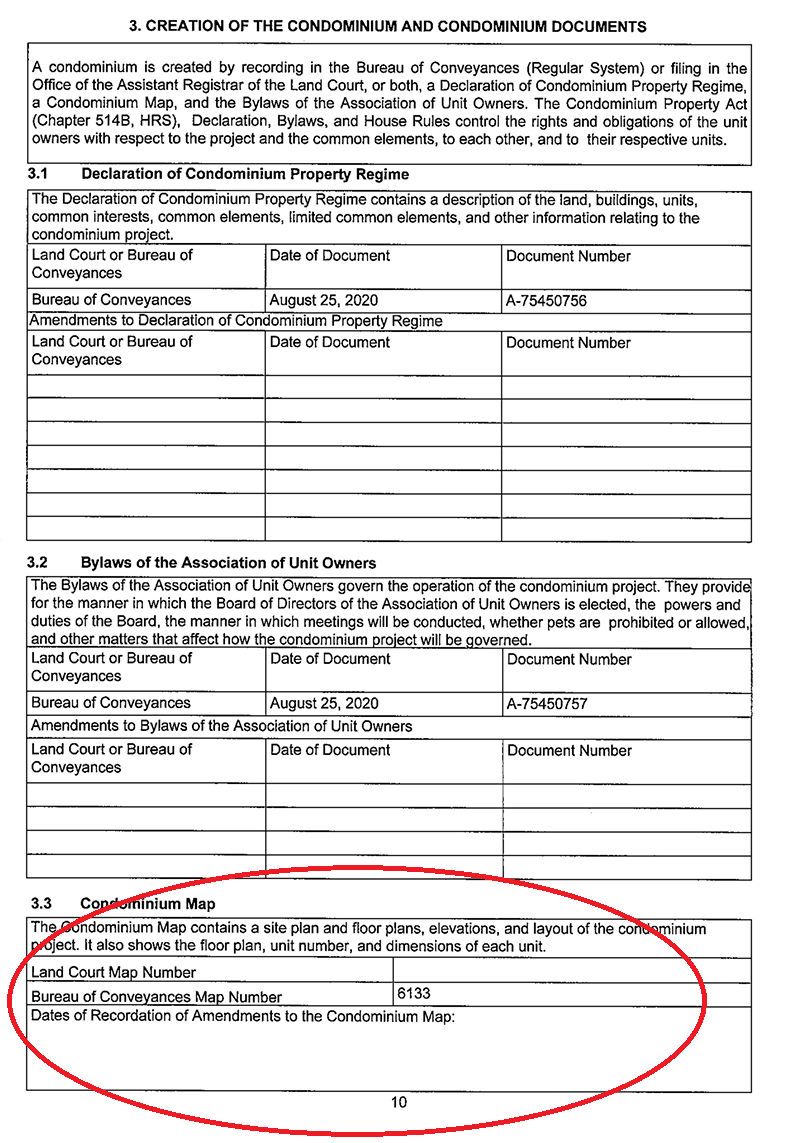
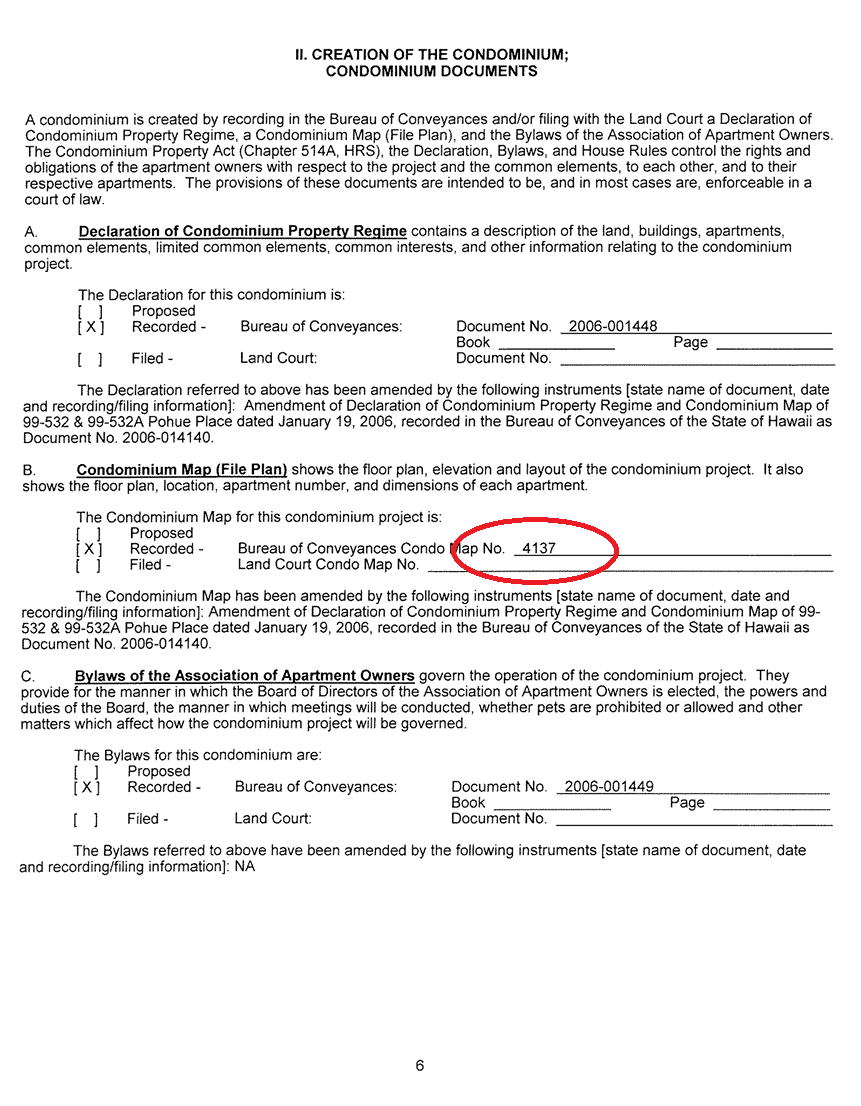
For updated maps, please contact the Bureau of Conveyances or the respective association for the condominium map you are searching for. You may request the maps from the Bureau of Conveyances via the online condominium map form. Maps can also be viewed in person in the Bureau of Conveyances reference room prior to purchase. Please have the map number and recording system for reference. Be aware that Bureau of Conveyances staff are unable to provide the contents of the map via phone or locate any information other than the map.
Updated 4/30/26
The Real Estate branch has a free developer and developer’s agents email subscription service, where periodic updates on condominium development, form changes, new development laws, and other aspects related to condominium development are disseminated.
Developer’s Public Report, Exhibits, Reserve Study, & Annual Report
No. There is no legal requirement that a developer must hire a lawyer to prepare the Developer’s Public Report and prior developers have prepared the registration themselves.
The Hawaii Real Estate Branch does have recommendations should a developer attempt to self-prepare the documentations:
- A developer by law must use the services of a licensed architect, engineer, or surveyor to prepare the map pursuant to section 514B-34(a), HRS.
- The developer’s public report process is made of two parts, the report itself that is made available to the public and the supporting documents such as the declaration, map, entity certificate of good standing, escrow agreement, financing/bonding agreements. The document checklist provides a lengthy and comprehensive list of documents that must be provided.
- Review the “So You Want To Go Condo” brochure.
- Confirm with the local county office in charge of permitting and zoning that what the developer intends to build is permissible under all county rules, regulations, zoning, and ordinances for that piece of property.
- Review the chapter 514B, HRS, forms, general information, and checklists PDFs.
- Review the “Developer’s Guide – Avoiding Common Errors: Chapter 514B, HRS, Developer’s Public Reports” PDF located in the forms page.
- Review or request a copy of a similar project’s supporting document packet. Prospective developers can search for prior projects using the Developer’s Public Report database located on the Resources for Condominium Developer’s page. Every project is assigned a registration number, with more recent projects in the 8000s series. Users can filter by various criteria, including location, zoning, and size. Reviewing how another project structured its supporting document packet can help a prospective developer in the registration process.
- All document requests to review or for copies must use the Office of Information Practice’s document request form: “Request to Access A Government Record.”
Yes, a title report is required with an application for a Developer’s Public Report.
While a title report is not explicitly listed in section 514B-54, HRS, as a required document, section 514B-54(a)(10), HRS, grants the Hawaii Real Estate Commission authority under to mandate “other documents and information that the commission may require.” Furthermore, section 514B-83(a)(8), HRS, requires the Developer’s Public Report to document “other facts, documents, or information that would have a material impact on the use or value of a unit or any appurtenant limited common elements or amenities of the project available for an owner’s use, or that may be required by the commission.” The title report serves as an indispensable tool to find easements, covenants, conditions, and restrictions, agreements, and liens to meet the requirements under section 514B-83(a)(8), HRS, that would materially impact the value of the property to a prospective buyer.
Please review the document checklist for the required documents.
10/15/25
The condominium law requires that most projects be registered with the issuance of an effective date by the Hawaii Real Estate Commission prior to any sales, pursuant to sections 514B-81and 82, HRS, and thus developers and their agents often ask what advertising is allowed prior to registration.
The condominium law has two key prohibitions for pre-registration solicitation pursuant to section 514B-85, HRS. Prior to a registration, developers or their agents “shall not collect any moneys from prospective purchasers or anyone on behalf of prospective purchasers.” Developers also “shall not require or request that a prospective purchaser execute any document other than a nonbinding preregistration agreement.” The short answer is in the act of advertising prior to the effective date, no moneys can be exchanged and no binding agreements can be signed.
5/15/2019
Yes. Developers are required to use a broker to sell units as they are explicitly not exempted from section 467-2(1), HRS.
Updated 12/9/19
Act 62, SLH 2022, mandated that the Developer’s Public report include a “breakdown of the annual maintenance fees, which includes the annual reserve contributions based on a reserve study.” The requirement for a reserve study to be conducted to determine the annual reserve contributions has resulted in confusion by developers and their agents in if this mandates hiring a reserve specialist. Currently, as written in chapter 514B, HRS, a reserve study preparer is only required by a condominium association to review its reserve study at least once every thee years pursuant to section 514B, 148(a)(5), HRS.
Therefore, a developer during the application for a Developer’s Public report can self conduct the reserve study needed to determine the annual reserve contributions as required by Act 62, SLH 2022.
If a developer or their non-reserve study preparer agent is conducting the reserve study, they should be aware that the study should cover all components the association is responsible for, that have a limited useful life generally within thirty years, that can be reasonably predicted as to their remaining useful life, and are of significant cost to require being reserved for rather than being treated as an operating cost. Common components often include roads and driveways, water treatment and waste disposal systems, elevators, spalling, roofs, plumbing, windows, and electrical.
Please review the related FAQ directly after this one, titled “My Project Has No Common Elements, What Should My Reserve Study Look Like?”
Updated 4/24/26
Act 62, SLH 2022, mandated that the Developer’s Public report include a “breakdown of the annual maintenance fees, which includes the annual reserve contributions based on a reserve study.” However, this office recognizes that not every condominium project has or will have common elements that require reserves. Act 62, SLH 2022, provides no exemption to such projects and thus projects with no common elements or will not have common elements still must provide a reserve study and an estimated annual reserve contribution.
Be aware that during the review, the attached reserve study will be examined to see if it the reserve the study covers all components the association is responsible for, that have a limited useful life generally within thirty years, that can be reasonably predicted as to their remaining useful life, and are of significant cost to require being reserved for rather than being treated as an operating cost. Developers will be required to amend the study and their reports for omitted components that meet the above requirements.
For a binding sale to occur, the developer must comply with section 514B-86, HRS. That section notes what documents must be provided to a purchaser in paper. Of those documents, if a “prospective purchaser, or purchaser [indicates] in a separate writing their election to receive the required condominium’s declaration, bylaws, house rules, if any, letter-sized condominium map, and all amendments through means of a computer disc, e-mail, download from an internet site, or by any other means contemplated by chapter 489E.”
Note that this section explicitly omits the developer’s public report from being allowed to be delivered by an electronic means and therefore the developer must provide a printed copy of the developer’s public report to a prospective purchaser or purchaser.
10/18/23
Yes. Developers in a project are responsible for all units in the project until all units are sold. Developers, particularly in smaller projects who only contributed a portion of the total property who then proceed to sell the unit they were living in, may reduce their future developer obligations and liabilities through a series of steps. These steps require updating the Developer’s Public Report disclosing their removal as a developer and recording an instrument that transfers their developer rights to the remaining developer(s) or someone else assuming their role as developer.
Updated 1/25/19
§514B-58, HRS, mandates that developers file an annual report until all units in the project undergo a bonafide sale. The report serves as a reminder to the developer to update the developer’s public report for any changes.
A common complaint from small project developers is the lack of exemption for developers who reside in a unit for the long term; however, should a developer intend to sell, the annual report serves as a reminder tool to ensure that developers have disclosed all material and pertinent facts within the developer’s public report.
At the time of sale, developers may forget about non-visible changes to the property, such as modifications to easement rights, view plane building restrictions, or bylaws governing commercial and pet practices, which may materially impact the value and usage of a unit to a buyer. The annual report serves to remind developers to promptly update their developer’s public reports as those changes occur. These continuous updates help to protect the developer from accusations of fraud and omission in a later sale by providing an up-to-date and standardized disclosure document to buyers.
Updated 7/2020
Congratulations on your final sale! However, you still have a few obligations as your time as developer ends as you exit the project with no ownership in any unit:
Please file your annual report with the Commission noting that all units have been sold. You now have no obligation to update the Developer’s Public Report.
Set up the association’s required bank accounts, insurance, and other requirements to create and operate the association if you have not already done so.
Turn over control of the association to the owners if you have not already done so pursuant to section 514B-102, HRS, and review any remaining developer rights you may have.
Updated 4/30/26
No. This is strictly prohibited. For a contract to be binding, the developer pursuant to §514B-86, HRS, must provide a true copy of the developer’s public report. Without amending the developer’s public report or registering the newly created units via a phase registration, the developer cannot meet the requirement of providing a true copy of the developer’s public report as the newly created units were not disclosed in that report.
Those newly created units are unregistered, not covered under any developer’s public report and have not met the legal requirements for sale.
10/30/25
Developer’s Public Report - Conversion & Verification Letters
Developers that are applying for a Developer’s Public Report on where the condominium project that contains a structure more than twelve months after the completion of the construction, must provide a county verified letter pursuant to section 514B-84(a)(2), HRS, that:
“The structures are in compliance with all zoning and building ordinances and codes applicable to the project at the time it was built, and specifying, if applicable:
(i) Any variances or other permits that have been granted to achieve compliance;
(ii) Whether the project contains any legal nonconforming uses or structures as a result of the adoption or amendment of any ordinances or codes; and
(iii) Any violations of current zoning or building ordinances or codes and the conditions required to bring the structure into compliance; or
(B) Based on the available information, the county official cannot make a determination with respect to the matters described in subparagraph (A);”
To alleviate confusion some developers and their attorneys have in asking their respective counties for these letters, the Real Estate Branch has provided several copies of such letters. These letters were pulled from publicly accessible developer’s public reports.
Kauai County Conversion Letter
Developers that are applying for a Developer’s Public Report on agriculturally zoned land must provide a county verified letter that the “project’s declaration, condominium map, bylaws, and house rules does not include any restrictions limiting or prohibiting agricultural uses or activities, in compliance with section 205-4.6, HRS, pursuant to section 514B-52(b), HRS.
To alleviate confusion some developers and their attorneys have in asking their respective counties for these letters, the Real Estate Branch has provided several copies of such letters. These letters were pulled from publicly accessible developer’s public reports or from the respective county website.
Kauai County Letter – Compliance Letter
City and County of Honolulu Letter
8/14/25
Chapter 514A, HRS, Repeal and Transfer into Chapter 514B, HRS
As a developer, or an original owner in a group of owners who had one individual act as developer (known as a “hui”), did my project transfer into chapter 514B, HRS, from chapter 514A, HRS?
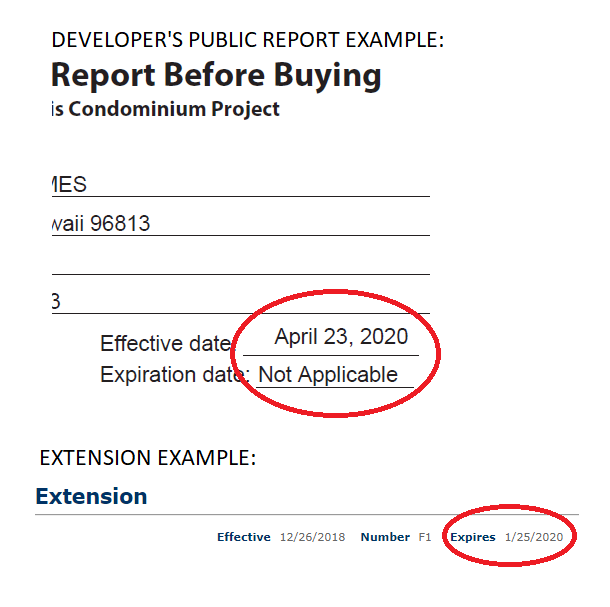
The requirements for the transfer into chapter 514B from chapter 514A, HRS, were that the developer’s public report be active and accurate between January 1, 2019 and July 1, 2020. You can check this by reviewing the effective date or extension date of the most recent report on our database, or on the physical copy of the report or a letter sent to you by the Hawaii Real Estate Commission. Please review this sample for examples of both.
Updated 7/2020
Please review our brochure, “Information for Developers Post Chapter 514A, HRS”
Updated 4/24/26
Amending your transferred chapter 514A, HRS project under chapter 514B, HRS utilizes the chapter 514B, HRS forms. Developers use the chapter 514B, HRS, amendment form located on the forms section.
Please review the “Developer’s Guide – Avoiding Common Errors: Chapter 514B, HRS, Amendments to the Developer’s Public Reports” PDF as it contains frequently asked questions on the second page about the specifics, namely that the developer attaches the relevant pages from the chapter 514B, HRS, form with the updated information to the chapter 514B, HRS, amendment form.
To engage in legal sales for units that were never sold, the project must re-register under chapter 514B, HRS. This includes units that are owned by the developer, the inheritors of original owners, and “hui” owners who delegated developer power to a specific individual but were original owners and never sold their units. Please review our developer memo for guidance in this process.
Please review the required forms and general information.
Please review the history of the repeal of chapter 514A, HRS.
Updated 8/13/2020